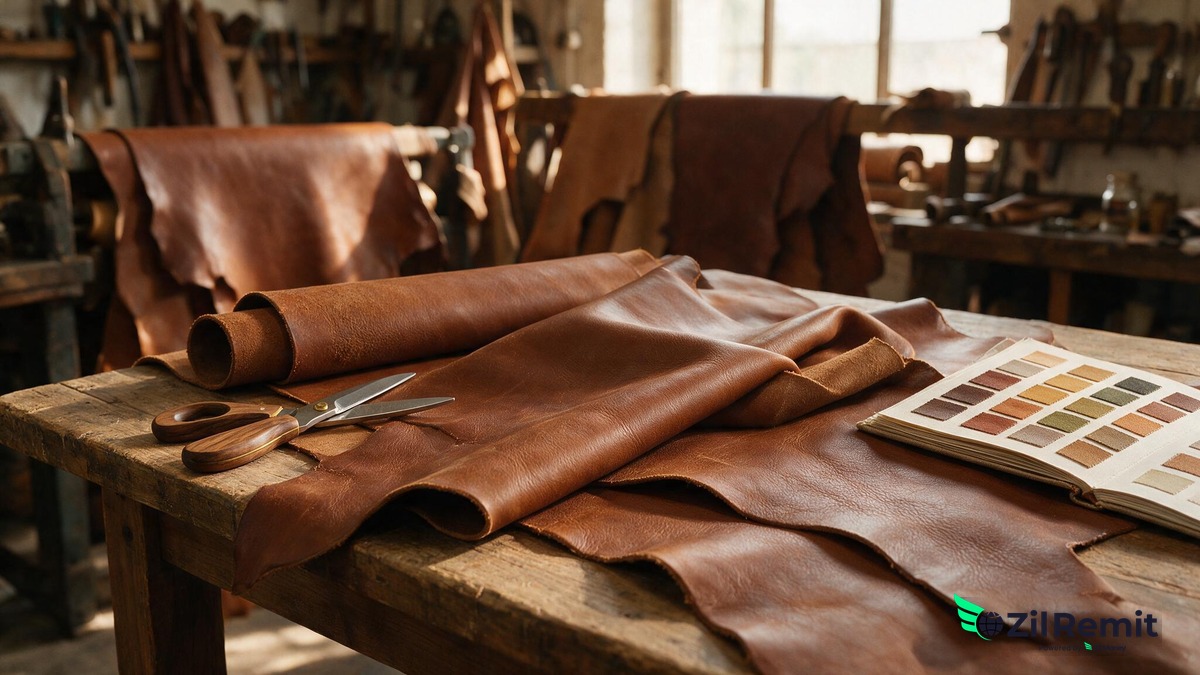
A Los Angeles apparel brand pays an Italian leather tannery in staged production payments tied to milestones: a deposit when the sample is approved, an optional progress payment at a mid-run quality check on larger orders, and a balance after final inspection. Each international payment references the tannery's IBAN, BIC, and the specific cutting ticket.
A Los Angeles apparel brand sourcing leather for a new bag or jacket line usually works with a tannery in Santa Croce sull'Arno, one of the world's largest vegetable-tanned leather districts. The tannery does not ship a hide the day a sample is approved. It waits for a deposit, starts cutting once that deposit lands, and holds the finished order until the balance clears. The payment schedule is part of the production schedule, not separate from it.
Key Insight: Most delays come from a payment problem, not a manufacturing one. Common causes: a beneficiary name that doesn't match the tannery's business registration, a missing causale the tannery needs to match your cutting ticket, or a deposit that lands after the next cutting slot fills.
What does an Italian tannery need to receive your payment?
An Italian tannery invoices in euros. Before it confirms your order, three things must match: the full IBAN (International Bank Account Number), a beneficiary name that matches its business registration, and a causale, the reference line Italian businesses use to match a payment to an invoice or purchase order.
| Component | Format | What it means |
|---|---|---|
| Country code | 2 letters | IT for Italy |
| Check digits | 2 digits | Validates the IBAN checksum |
| CIN | 1 letter | Internal control character |
| ABI code | 5 digits | Identifies the tannery's bank |
| CAB code | 5 digits | Identifies the bank branch |
| Account number | 12 characters | The tannery's own account |
The BIC (also called a SWIFT code) is separate from the IBAN: a bank code, country code, and location code, sometimes with a branch code added. A small family-run tannery may also list its partita IVA, an Italian VAT registration number, on the invoice. That number identifies the business itself and is worth checking against the beneficiary name on the payment, since some tanneries invoice under a holding company name that differs from the brand name on their swatch book.
A US-to-Italy payment crosses currency zones, so it can route through one or more correspondent banks. Ask your bank or payment provider whether you are covering the full correspondent fee (often labeled OUR) or splitting it with the tannery (SHA), so the amount the tannery actually receives matches the invoice.
How does the deposit-to-balance payment schedule work?
Italian tanneries and mills typically stage payment against the production milestones, not one lump sum: a buyer's finance team sends several smaller international payments tied to specific dates on the production calendar instead of a single bulk-goods transfer.
| Production milestone | Typical payment | What it unlocks |
|---|---|---|
| Sample approved | A partial deposit, often in the 20-30 percent range | Tannery reserves hide stock and a cutting slot |
| Cutting ticket issued | No new payment, deposit already covers this | Cutting run begins against the approved sample |
| Mid-run quality check | Progress payment on larger orders, negotiated per contract | Production continues toward finishing and dyeing |
| Final inspection passed | Balance, the remaining amount due | Order is released for shipment with the transport document |
Do you pay before or after the leather is cut? Before. Tanneries in Santa Croce sull'Arno start cutting only after a partial deposit lands, then hold the finished order until the balance clears after final inspection.
These percentages and stages vary by tannery and order size and are not set by Zil Remit, so confirm the exact split with your tannery in writing before the first payment goes out.
Who absorbs the FX risk between a tannery's deposit and balance payment? This is not automatic. Confirm upfront whether the balance is fixed at deposit-time rate or recalculated at final invoice, since staged payments can span weeks of currency movement, and build that answer into your production budget.
Paying the Santa Croce sull'Arno tannery, step by step
Confirm the beneficiary name and the deposit percentage
Match the beneficiary exactly to the business name on the tannery's registration and invoice, not the trade name on its sample book. Get the deposit percentage and balance timing in writing.
Verify the full 27-character IBAN and BIC once, then reuse it
Check the ABI and CAB codes against the bank name the tannery gave you. Because this is a staged order, save the verified IBAN and BIC for the deposit, any progress payment, and the balance, and only re-verify if the tannery tells you its bank has changed.
Add the causale, tied to your cutting ticket or purchase order
Use the reference from the tannery's invoice. Reuse that order number on every stage payment, so the tannery can match the deposit and balance to the same order.
Send each stage payment on its own schedule
Ask what fees and exchange rate apply before you send, so the amount that lands matches what you budgeted for that stage. Send through Zil Remit, built to deliver as a standard IBAN credit your tannery's bank can process, and repeat for the deposit, any progress payment, and the balance.
Keep the confirmation with your import paperwork
The documento di trasporto (DDT) is the tannery's own Italian dispatch document, proof on their side that the goods left the workshop; it is not a US customs form. For US entry, keep this payment confirmation with the commercial invoice and, if your customs broker wants a paper trail on origin, a certificate of origin.
What mistakes stall a cutting run?
These five mistakes are the ones that most often stall a cutting run.
- Sending the balance before the quality check, which removes your leverage to ask for a rework if the finished hides don't match the approved sample.
- Reusing one causale across multiple orders instead of a unique reference per purchase order, which makes it hard for the tannery's finance team to tell a deposit from a balance.
- Not confirming who covers the euro-to-dollar timing gap between the deposit and the balance, leaving the final invoice amount a surprise weeks later.
- Scheduling a deposit or balance to land during Ferragosto. You can send the international payment, but the tannery is typically closed to act on it. Most Tuscan tanneries shut for the mid-August holiday, so a payment that lands during the closure won't move a cutting ticket until they reopen.
- Paying a minimum order commitment as if it were a simple deposit, without confirming what happens to that payment if a sample is later rejected.
A different supplier, the same corridor
Not every US business paying an Italian supplier is managing a production calendar. See how a Boston food importer pays its Italian olive oil supplier for a different kind of Italy payment.
| This article | Boston olive oil importer article |
|---|---|
| Staged deposit, progress, and balance payments across a production run | One seasonal payment tied to a harvest window |
| Timing risk: cutting slots and Ferragosto closures | Timing risk: harvest deadline and Ferragosto closures |
The IBAN and causale basics carry over between the two, but the timing pressure and the number of payments per order do not.
Getting the payment right the first time
Paying an Italian tannery is straightforward once the beneficiary name, the IBAN, and the causale line up with what the tannery's own finance team is expecting, and once the deposit and balance are scheduled around their production calendar instead of yours. Run a short pre-payment check: confirm the beneficiary, validate the IBAN, match the reference to the cutting ticket. That catches the mistake before it costs you a production slot. For general international-payment mechanics beyond this one corridor, see our complete guide to international business payments.
Ready to pay your Italian tannery?
Send an international payment to Italy that arrives as a standard IBAN credit your supplier's bank can process, with the fees and exchange rate shown before you send.
Send Your Deposit to Italy