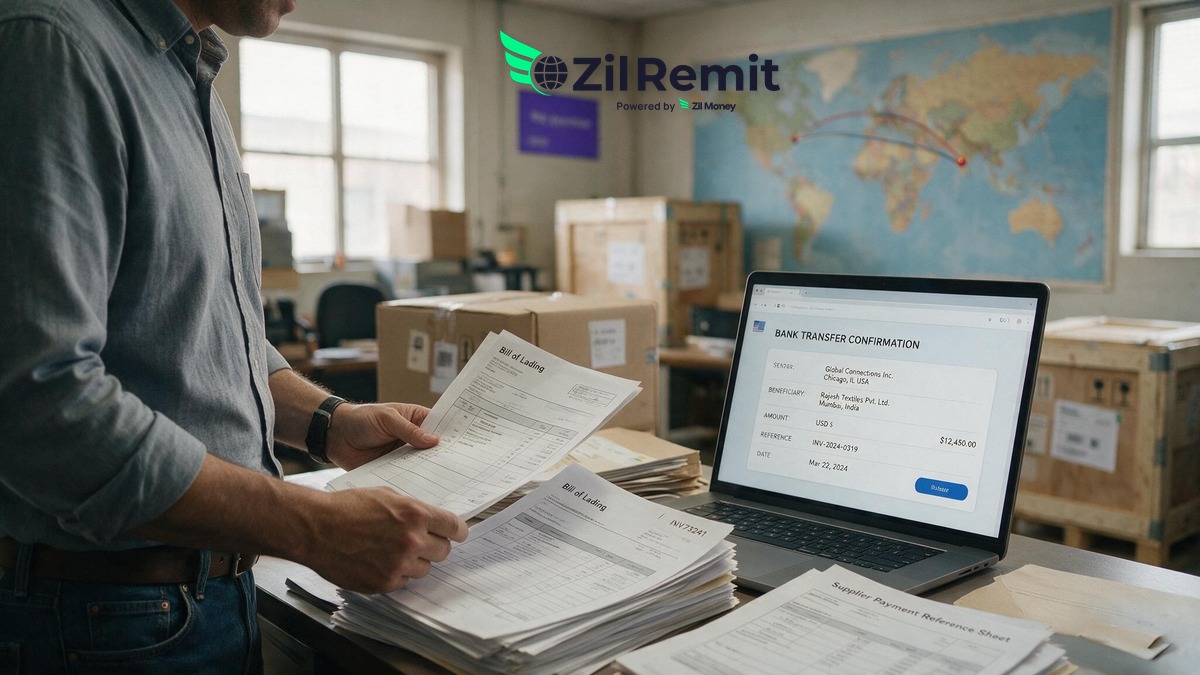
A small import-export business in Chicago that buys textiles, components, or finished goods from a supplier in India runs into a different set of problems than someone sending a one-time gift to family overseas. The supplier expects to be paid on the same terms every month. The bookkeeper needs a paper trail that matches each payment to an invoice. And a single wrong digit in a bank routing code can send the payment to the wrong branch entirely, not just delay it.
Getting these details right matters as much as sending the money on time. This is what it actually takes for a small business to pay suppliers in India and keep a paper trail an accountant can follow, part of the everyday work behind small business international payments that most guides skip past.
Key Insight: An Indian IFSC code is 11 characters, not 10. The first 4 letters identify the bank, the 5th character is always a reserved zero, and the last 6 identify the branch. Dropping that 5th character is an easy mistake to make, and one worth double-checking before it causes a delay.
What You Need From an India-Based Supplier Before the First Payment
To pay a supplier in India, you need four things before the first payment goes out: their IFSC code, their account number and legal account name, a purpose code for the payment, and a reference number tied to the invoice. Get all of it in writing, not over a phone call or a quick chat message. Ask for the exact legal name on the account (it should match the name on their invoice and GST registration, if they have one), the account number, the IFSC code, and the bank branch address. A mismatch between the invoice name and the bank account name can trigger a manual review and delay the payment.
IFSC code (11 characters)
Format: 4 letters for the bank, then a reserved "0," then 6 letters or numbers for the branch. Example pattern: ABCD0123456. If what the supplier sent you is only 10 characters, ask them to confirm it. India's major bank-transfer networks route on this code, so a wrong character sends the payment to the wrong branch, not just late.
Account number and account name
Confirm the exact spelling and spacing of the account holder name. Indian business accounts are often held in the name of a private limited company or a proprietorship, and even a shortened version of that name can trigger a name-matching hold.
Purpose code
Indian regulations require a purpose code on incoming international payments, for example goods trade, software services, or consulting. Ask your supplier which category their goods fall under so you have that classification ready when it's requested during the payment. That code follows the payment past your own paperwork: the receiving bank uses it to issue your supplier a Foreign Inward Remittance Certificate, which they need for their own GST records. Getting the code right on your end saves your supplier a compliance headache on theirs.
Settlement currency
Ask your provider whether the payment lands in your supplier's account as Indian rupees or US dollars. A payment that settles in rupees usually reaches the supplier's account ready to use, while one that settles in dollars may need a second conversion on their end, adding a step and a cost neither of you sees until after the fact. It's a small detail among the small business international payments questions worth asking upfront, before it turns into a shortfall your supplier has to flag.
Setting Up Recurring International Payments to the Same India Supplier
A Chicago business ordering fabric, hardware, or packaging from the same manufacturer in India month after month benefits from saving that supplier's bank details once instead of re-entering them for every purchase order. Reusing verified details also cuts down the chance of a typo creeping into the account number or IFSC code on a payment made under deadline pressure.
When a payment repeats on a predictable cycle, weekly, biweekly, or after each shipment, treat it the same way you'd treat a domestic vendor bill: matched to a purchase order, tied to an invoice number, and logged with the date it was sent. This is less about the sending tool and more about the discipline of building a habit before your supplier list grows past two or three names.
If a bookkeeper had to reconstruct six months of supplier payments to India from your records today, could they match every payment to an invoice without asking you a single question?
Why the Reference Number Matters for Supplier Payments to India
Every international payment should carry a reference that ties it back to a specific invoice or purchase order, not just the supplier's name. When tax season arrives, or when a supplier disputes whether a shipment was paid for, the reference number is what closes the argument fast, without hours of digging through statements. Build a simple naming convention early: invoice number, order date, and a short supplier code works for most small operations.
Keep a copy of the payment confirmation alongside the supplier's original invoice and the shipping documents: the bill of lading or airway bill, and the packing list. Import-export payments carry a burden most other international payments don't. A customs officer, not just your bookkeeper, may need that trail to line up with the physical shipment it paid for.
Best Practices for Paying Suppliers in India
Confirm supplier bank details in writing
Legal account name, account number, IFSC code, and branch address, sent as text or a document, never verbally.
Confirm the IFSC code length
It should be exactly 11 characters. Ten usually means the reserved 5th character was dropped by mistake.
Attach a reference number to every payment
Tie it to the invoice or purchase order so your bookkeeper and the supplier can both trace it later.
Save the supplier as a repeat recipient
Once verified, reuse the saved details for future orders instead of retyping them under deadline pressure.
File the payment confirmation with the shipment paperwork
Keep the invoice, bill of lading, and payment confirmation together for each order.
Ask what currency the payment settles in
Rupees or dollars changes what your supplier's bank does with it next, and neither of you wants to find out after the fact.
Conclusion
Get the IFSC code and account name right on the first payment. Save the supplier's details so you're not retyping them under deadline pressure every order. Tag every payment with a reference number your bookkeeper can trace without calling you. Do those three things once, and paying a supplier in India stops being a monthly fire drill and starts running like any other vendor bill.
Ready to Pay Your India Supplier?
See how Zil Remit handles international payments to India for small businesses paying suppliers regularly.
Send Money to India