To send money to Sweden for a steel mill's invoice, match the payment to the final commercial invoice and confirm the mill certificate cites the same heat number as the shipment. Then pay in the currency the invoice actually states, since Swedish mills often invoice in euros or dollars, not krona.
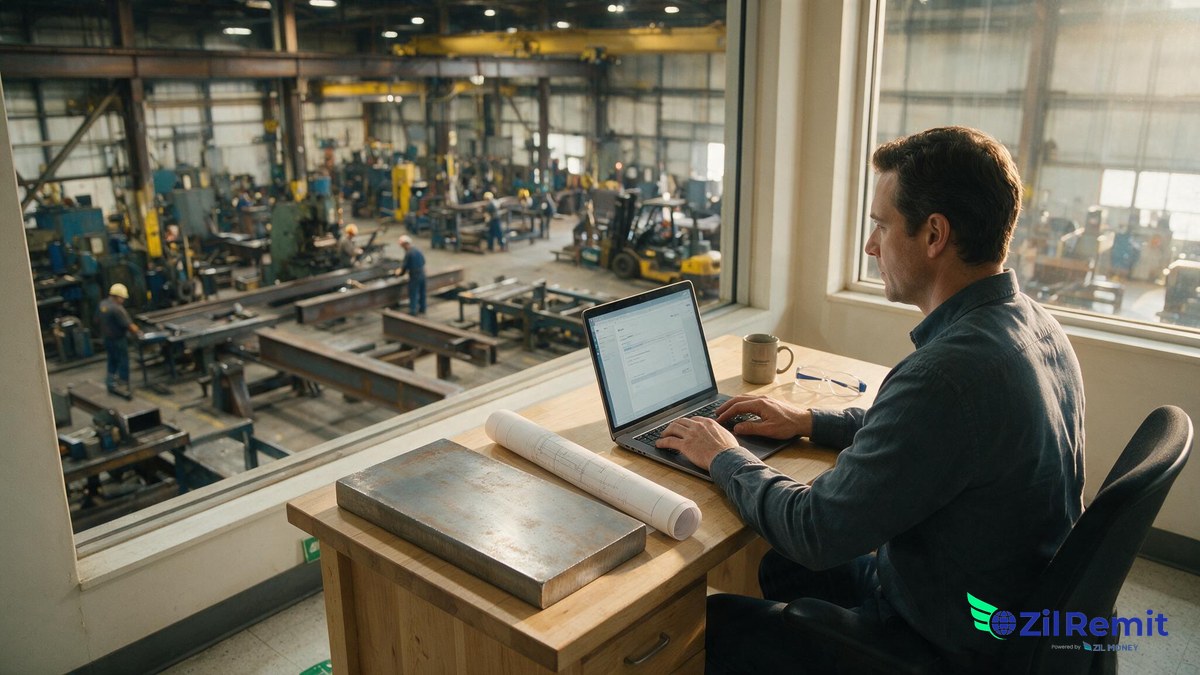
A Peoria, Illinois fabricator builds dump-truck bodies, buckets, and quarry attachments. It runs this cycle on every overseas plate order: the mill rolls the wear-resistant plate, tests it, issues a certificate, and sends a commercial invoice. The Peoria shop's job is simple to state and easy to get wrong: get the right amount to the right account, with the certificate matched to the shipment, before the plate hits the cutting table.
Key Insight: If you're paying a Swedish mill for wear-resistant plate, there's a good chance it's a producer like SSAB, known worldwide for its Hardox and Domex steel grades. Paying that invoice correctly still comes down to three things: the right legal entity name, the right currency, and a mill certificate that matches the actual shipment.
This Is a Raw-Material Payment on a Purchase Order, Not a Generic Sweden Guide
A steel-plate payment carries paperwork a personal transfer never touches. You need a commercial invoice matched to a purchase order, a mill certificate tied to a heat or lot number, and an HS code your broker files. Imported steel may also owe Section 232 tariffs on top of ordinary duty. Missing any one of those slows the payment down, or creates a mismatch a bank or customs broker flags for review.
If the mill certificate doesn't clearly reference the same heat number as the plate that shipped, ask for a corrected or supplemental certificate before you release the balance payment. A dispute after the plate is already welded into a truck body is a far worse conversation than a short delay before payment. This is general information, not legal or tax advice, so confirm any unusual case with your customs broker or accountant.
| Steel Plate Payment (Raw Material) | Service Invoice Payment | |
|---|---|---|
| Documentation | Commercial invoice, mill certificate (often EN 10204 3.1), bill of lading, HS code | Not applicable, nothing physically crosses the border |
| Customs/tariff exposure | Ordinary duty plus possible Section 232 steel tariffs, rates that have changed over time | Generally none |
| US tax form | Usually none, a goods purchase typically isn't US-source income to the mill | A W-8BEN-E may apply, depending on the service |
| Typical dispute trigger | Heat-number mismatch, short shipment, or a spec that doesn't match the PO | A missed or incomplete deliverable |
The Document Chain, Proforma to Payment
A deposit, if the mill requires one, is typically paid against the proforma (#1). The balance is paid against the commercial invoice (#4). The purchase order and mill certificate exist to confirm both are correct, not to trigger a payment themselves.
What Your Swedish Steel Mill Needs From You Before You Pay
Collect these details in writing, directly from the commercial invoice and the mill's own bank confirmation, not read off a call or pasted from an old email thread:
Full legal entity name, matched to a bank confirmation letter
Use the name exactly as it appears on the commercial invoice, and check it against a bank confirmation letter from the mill, not the mill certificate, which verifies steel quality, not banking details. Some mills sell through a separate export or trading arm with a different legal name than the production plant listed on the certificate. That mismatch is one of the most common reasons a payment to a Swedish supplier gets held for review.
IBAN and BIC/SWIFT code
Take both fields directly from the invoice or the mill's bank confirmation, never retyped from a previous order or a chat message. Swedish IBANs follow a fixed format starting with "SE" followed by 22 digits. A copy-paste error in either field is the single most common reason a first payment to a new mill gets returned.
The final commercial invoice, not the proforma
The proforma sets the price and terms the purchase order confirms, and is usually what any deposit is paid against. The commercial invoice reflects what actually shipped, including any change to thickness, tolerance, or quantity, and is the document your balance payment, your customs broker's entry, and your own accounting records should all point back to.
A mill certificate that matches the shipment's heat number
EN 10204 3.1 is the standard mill-test-certificate type for structural and wear-resistant steel plate: the mill's own inspection representative, independent of the production department, validates that the specific batch meets the ordered grade. The certificate should reference the same heat or lot number as the plate on the bill of lading, and confirm the grade and thickness you ordered. Check this before you release the balance payment, not after the plate is already on the shop floor.
SEK, EUR, or USD: Which Currency Should You Send?
Don't assume a Swedish mill invoices in krona. Steel plate is traded internationally, and it's common for Swedish export mills to price large orders in euros or US dollars even though the krona is Sweden's own currency. Confirm the invoice currency first. If you guess wrong, the receiving bank picks the exchange rate, not you.
| Send in the Invoice Currency | Send in a Different Currency | |
|---|---|---|
| Matches the commercial invoice | Yes, whether that's SEK, EUR, or USD | Only if the mill has specifically agreed to accept it |
| Who sees the exchange rate first | You, before you confirm the payment | The mill's bank, after the payment arrives |
| Best for | The standard case, matching whatever the invoice states | A one-off case the mill has confirmed in writing |
Whichever currency the invoice states, get that confirmed with the mill in writing, so there's no ambiguity when you review the total before the payment goes out.
Sending the Payment, Step by Step
Match the commercial invoice to the purchase order
Confirm plate grade, thickness, tolerance, and quantity against what actually shipped, not the earlier proforma quote.
Check the mill certificate against the invoice
Confirm the EN 10204 3.1 certificate references the same heat or lot number as the shipment, and that the grade and thickness match what you ordered.
Verify the beneficiary name against the mill's bank confirmation
Check the invoice name and the IBAN holder point to the same legal entity, since some mills invoice through a separate export or trading arm.
Confirm the invoice currency and review the rate
Check whether the invoice is in SEK, EUR, or USD, and review the exact amount going out before you confirm the payment.
Send with the invoice number attached, and file it
Keep the confirmation with the commercial invoice, the mill certificate, and the customs entry paperwork, so the full purchase order file matches at audit time.
Mistakes That Slow Down a Payment to a Swedish Steel Mill
| Mistake | Consequence |
|---|---|
| Paying against the proforma instead of the final commercial invoice | Amount can be wrong if thickness, tolerance, or quantity changed between quote and shipment |
| Assuming the invoice is in Swedish krona without checking | Conversion happens on the mill's end instead of yours, and the amount received can fall short of the invoice |
| Beneficiary name doesn't match the mill's bank confirmation letter | Payment held for manual review, especially if the mill invoices through a separate trading arm |
| Releasing the balance before checking the mill certificate's heat number | A spec or heat-number mismatch surfaces after the plate is already cut, instead of before payment |
| Leaving off the invoice number in the payment reference | Mill's finance team can't match the payment to a specific purchase order |
| Not confirming current Section 232 and duty rates before finalizing the PO | Landed cost surprises the buyer after the plate has already shipped |
Common Questions
What does my Swedish steel mill need from me before I send the payment?
Get the mill's full legal entity name, its IBAN, its bank's BIC or SWIFT code, and the commercial invoice number, in writing. Match the entity name against the mill's own bank confirmation letter, not the mill certificate, which verifies the steel, not the bank account.
Should I pay a Swedish steel mill in SEK, EUR, or USD?
Pay in whatever currency the commercial invoice states. It's common for Swedish steel exporters to price large export orders in euros or US dollars even though Sweden's own currency is the krona, since steel plate is traded internationally in those currencies. Confirm the invoice currency before you send, and don't assume it's automatically SEK.
Do I need the mill certificate before I pay, or can it come after?
Get the mill certificate, usually issued to EN 10204 3.1, checked against the invoice before you send the balance payment. It should cite the same heat or lot number as the shipment. A deposit at order confirmation is common; paying the full balance before checking the cert removes your chance to catch a mismatch first.
Does this payment need an HS code or affect steel tariffs?
The payment carries no HS code itself, but your customs broker files one under the steel tariff chapter, matched to grade and dimensions. Imported steel may also owe Section 232 tariffs on top of ordinary duty. Confirm current landed cost with your broker before finalizing the PO.
How long does a business payment to Sweden take to arrive?
There's no single fixed timeline: it depends on the receiving bank and any correspondent banks along the route. What you can control is starting the payment early enough that a routine delay doesn't put you up against the mill's shipment release deadline.
What's the biggest reason a payment to a Swedish mill gets delayed?
A mismatch between the beneficiary name on the IBAN and the legal entity name on the commercial invoice. Some mills sell through a separate trading or export arm with a different legal name than the production plant on the mill certificate. Banks on both ends flag that kind of mismatch for manual review.
What if the mill can't produce an EN 10204 3.1 certificate for this shipment?
Hold the balance payment until you have it, or get a written commitment for exactly when it will follow. Without a certificate tied to the shipment's heat number, you can't confirm the plate meets the ordered grade, and a later warranty or spec dispute has no paper trail to stand on.
Do I need a W-8BEN-E on file for a Swedish steel mill?
A W-8BEN-E generally applies to payments the IRS treats as US-source income to a foreign entity, such as services or royalties. A straightforward purchase of steel plate from Sweden usually isn't the kind of payment that triggers this form. Confirm with your accountant if the relationship includes testing or licensing services beyond the plate purchase.
What if the mill says the payment hasn't arrived, or the amount looks short?
Keep the payment confirmation and invoice reference on hand. A short amount usually traces back to a correspondent bank deduction or a currency mismatch. If your mill reports the payment hasn't landed, contact Zil Remit's support team with the confirmation and invoice reference, and they'll work with the receiving bank to trace it.
Pay the Invoice and Certificate You Actually Have, Not a Generic One
A steel invoice from a Swedish mill doesn't need to turn into a research project every purchase order. Match it to the final commercial invoice. Confirm the mill certificate's heat number matches the shipment. Verify the beneficiary name against the mill's bank confirmation. Pay in the currency the invoice actually states. Get those four checks right and the payment goes smoothly the first time.
Related reading:
- For how another US manufacturer pays a Swedish supplier for a different kind of goods order, see how a Minneapolis furniture manufacturer pays its Swedish wood-components supplier.
- For locking in the exchange rate before a large supplier invoice comes due, see Zil Remit's guide to mitigating foreign exchange risk on payments to Sweden.
- For the fee side of a large B2B payment to Sweden, see Zil Remit's guide to avoiding hidden fees when sending money to Sweden.
- For how another US manufacturer handles a similar goods purchase from a European supplier, see how a Denver medical device company pays its Irish manufacturing supplier.
- For the tax-form details on paying a foreign vendor, the IRS's own W-8BEN-E instructions are the primary source.
Ready to see the rate for this payment?
Get a quote for your mill's Swedish bank account, with the exchange rate, the total cost, and a confirmation record shown before you send.
Get Your Sweden Rate Quote