To send a $10,000 business payment to the Philippines, send the full invoice amount directly to your supplier's exact bank details: legal business name, account number, SWIFT/BIC code, and branch. Attach the invoice number as the payment reference. Sent this way, the transfer is documented as a trade payment rather than a personal remittance.
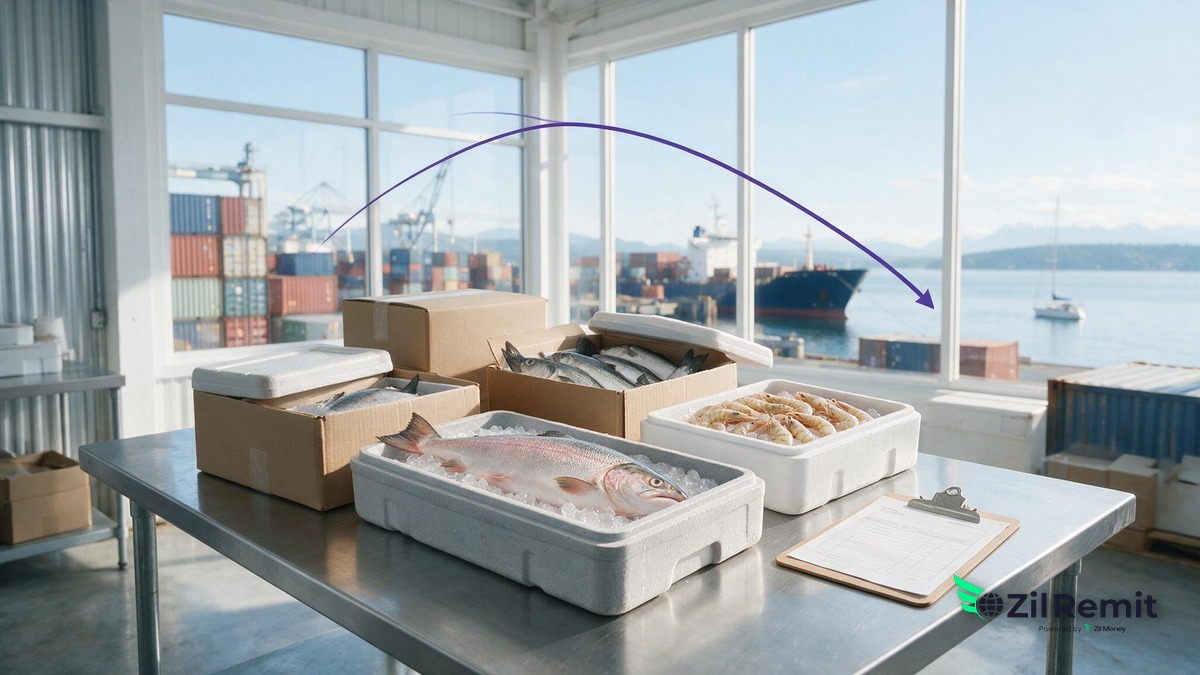
A Seattle seafood exporter and a processing partner in Cebu or General Santos run this cycle every order. The catch ships out. The processor cleans, packs, and freezes it to export spec. Then an invoice comes back for the processing fee or the finished product, often landing right around $10,000.
Key Insight: A $10,000 business payment is large enough that Philippine banks apply real anti-money-laundering screening to it, but it is not an unusual amount for a trade invoice. The payments most likely to move without delay share three things: the beneficiary name matches the processor's bank records exactly, the bank details are complete before the payment is sent, and the invoice reference travels with the payment.
This Is a Supplier Invoice, Not Money Sent Home
Most guides for sending money to the Philippines are written for someone paying a family member's grocery bill or a personal expense. A $10,000 payment to a seafood processing partner is a different transaction entirely: it is tied to a purchase order, it needs to reconcile against an invoice in your accounting system, and your processor's bank will treat it as a business receipt, not a personal deposit.
Sending it through a personal remittance app built for family transfers is where exporters run into trouble.
| Business Invoice Payment | Personal Remittance App | |
|---|---|---|
| Invoice/PO reference field | Attaches to the payment so it reconciles to the order | Usually not available |
| Transfer size | Built for trade-sized payments | Often capped or flagged at business amounts |
| Record for your bookkeeper | Confirmation you can file against the invoice | Personal transfer receipt, not a business record |
What Your Processing Partner Needs to Give You First
Zil Remit sends directly to major Philippine banks, including BDO Unibank, BPI, and Metrobank, so the payment lands straight in your processor's existing business account. Before you send anything, get these details in writing, on an invoice or letterhead, not read off a phone call:
Full legal business name
The name on the payment must match the name on the processor's bank account exactly, not a shortened trading name from an email signature or invoice header. A mismatch is one of the most common reasons a business payment gets held for manual review.
Account number, SWIFT/BIC code, and branch
Every major Philippine bank has one institution-wide SWIFT/BIC code the payment routes through, for example BDO's is BNORPHMM, BPI's is BOPIPHMM, and Metrobank's is MBTCPHMM. The branch code tells the bank which branch credits the processor's account. You need both fields. Confirm with your processor whether any correspondent-bank deduction applies before you finalize the invoice amount, so the number they expect to receive matches what actually lands.
The exchange rate and total cost, before you confirm
Zil Remit shows the USD to PHP exchange rate and the total cost of the transfer upfront, before the payment is sent, so the peso amount that reaches your processor's account is known in advance, not discovered after the fact. For example, if the day's rate is PHP 56 to the dollar, a $10,000 payment converts to about PHP 560,000 before any fee, and your exact rate and fee are shown on screen before you confirm.
How to Structure a $10,000 Seafood Processing Payment
Not every $10,000 invoice should move as one lump sum. How you structure it depends on what the processor is doing with your product before it ships back to you.
A processing-fee arrangement, where your own catch goes out for cleaning and packing, often works as a single payment against the finished invoice. A purchase-style contract, where the processor is also sourcing or supplying product for re-export, is more likely to use a deposit or a bill-of-lading-tied payment, since title to goods is changing hands.
This is a different decision from structuring, which means deliberately breaking one payment into smaller amounts to dodge a reporting threshold. Splitting one invoice into smaller payments to dodge review is a compliance violation on its own. Splitting a contract into a deposit and a balance tied to real delivery milestones is not. Each piece has its own documented trigger and its own paper trail.
| Structure | When it fits | What to attach to the payment |
|---|---|---|
| Single payment against a finished invoice | Product is already processed, packed, and ready to ship or has shipped | Commercial invoice and packing list reference number |
| Deposit and balance split | Processor needs funds to cover raw material or cold-storage costs before work starts | Proforma invoice for the deposit, commercial invoice for the balance |
| Payment on confirmed pre-shipment | Contract ties payment to a bill of lading or export certificate, not just a finished-goods date | Bill of lading number and export/health certificate reference |
Whichever structure your contract uses, put the invoice or purchase order number in the payment reference field every time. That single detail is what lets your processor's bookkeeper match the incoming payment to the right order without calling you to ask.
Sending the Payment, Step by Step
Pick the structure that matches your contract
Decide whether this is a single payment against a finished invoice, a deposit and balance split, or a pre-shipment payment tied to a bill of lading. Then get the legal business name, account number, SWIFT/BIC, and branch on an invoice or letterhead. Don't take them over the phone.
Save the processor as a recipient once
Add their details to your business account so future orders reuse the same verified information instead of re-entering it each time.
Review the exchange rate and total cost
Check the USD to PHP rate and the total cost of the transfer before confirming, the same way you would check a purchase order before releasing payment.
Attach the invoice or purchase order number
Put the reference number in the payment memo so your processor's bank can match the deposit to the right order on their side.
Send the payment and keep the confirmation
File the payment confirmation with the purchase order and commercial invoice, separate from any personal transfers, so your bookkeeper can reconcile it at tax time.
Mistakes That Delay a $10,000 Payment to the Philippines
| Mistake | Consequence |
|---|---|
| Paying against a shortened trading name instead of the processor's registered legal name | Payment held for manual review at the receiving bank |
| Splitting $10,000 into smaller amounts to "keep it simple" | This is called structuring, a compliance violation on its own, not just a way to draw more scrutiny |
| Sending through a personal remittance app instead of a business payment account | No invoice reference, transfer caps, and no record your bookkeeper can use |
| Leaving out the invoice or purchase order number | Slows the processor's reconciliation of which order the payment covers |
| Confirming bank details the day the payment is due | No time to fix a wrong digit in the account number or SWIFT/BIC before the deadline |
Common Questions
Can I send exactly $10,000 to a Philippine supplier, or should I split it into smaller payments?
No. A single, well-documented $10,000 payment does not need to be broken up. Splitting a payment specifically to stay under a reporting threshold is called structuring, and it is treated as a compliance violation in its own right, not just a way to draw attention. Send the full invoice amount at once with the reference attached, and let it move through normal screening.
What does my Philippine processing partner need to give me before I send $10,000?
Your Philippine partner should give you their full legal name as registered, bank account number, SWIFT/BIC code, branch name or code, and registered bank address, in writing on letterhead or a signed invoice, not by text or phone call.
Is the USD to PHP exchange rate locked before I send, or does it float?
Locked. Zil Remit shows the exchange rate and total transfer cost before you confirm, so the peso amount your processor receives is fixed at that point, not discovered later.
What triggers extra compliance review on a payment this size?
Philippine banks apply anti-money-laundering and know-your-business screening to inbound international payments, with more scrutiny when the invoice, business name, or documentation is incomplete. A clean $10,000 payment with a matching beneficiary name, a real invoice reference, and complete bank details is far less likely to be delayed by that screening.
What is the most common mistake exporters make sending a payment like this?
The most common mistake is paying a shortened trading name instead of the processor's full legal business name on file with their bank. That mismatch is one of the biggest reasons a payment gets held for manual review.
Should I use a personal remittance app to send a $10,000 business payment?
No. Personal remittance apps are built for sending money to family and often cap or flag business-sized transfers. A $10,000 invoice payment should go through a business payment account that can attach an invoice reference and issue a record your bookkeeper can use.
Send the Invoice, Not a Guess
A $10,000 payment to a Philippine processing partner does not need to be complicated. Confirm the legal business name and full bank details in writing, pick the payment structure that matches your contract, attach the invoice number, and check the rate before you send. Zil Remit sends the payment directly and keeps a confirmation record on file that you can hand your bookkeeper alongside the invoice. For how the same structured-payment approach plays out with a different perishable-goods supplier, see how a specialty foods importer pays an overseas supplier, and for a broader framework, see a step-by-step guide to paying overseas suppliers.
Ready to send this $10,000 business payment?
Send this invoice payment directly to your Philippine processing partner's BDO, BPI, or Metrobank account, with the rate, the total cost, and a confirmation record shown before you confirm.
Send This $10,000 Payment